
Interview With Koch Winery Co-Winemaker Gustavo
16th July 2025
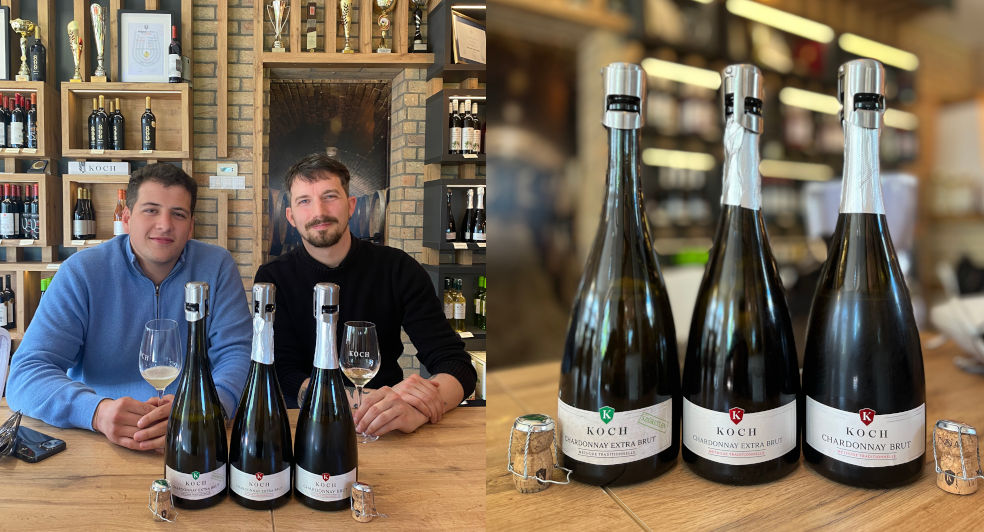
Just a couple of hours south of Budapest lies the Hajós–Baja wine region, a sun-soaked corner of the Great Hungarian Plain where innovation and tradition meet in the cellars of Koch Winery. During my visit, I had the chance to explore their impressive state-of-the-art facility and sit down with Gustavo, co-winemaker alongside owner Csaba Koch. Gustavo brings an international perspective rooted in deep agricultural heritage and technical training from Germany—an outlook that’s clearly reflected in their precise, characterful wines. Among their diverse offerings, Koch Winery has developed a focused trio of traditional method sparkling wines—each crafted with intent, and each showcasing a distinct interpretation of Chardonnay grown in the unique soils of the Great Hungarian Plain. After our conversation, I couldn’t wait to taste them—each glass a story of place, climate, and craftsmanship.
Can you tell us a little about yourself and how your journey into the wine industry began?
I am Ecuadorian and Chilean, born into a family of farmers, where working with the land was not just a profession but a way of life. I grew up deeply connected to agriculture – not only surrounded by plantations, but immersed in the broader reality of the countryside, where respect for nature, hard work, and community go hand in hand.
From an early age, I developed a deep passion for farming, a strong respect for the soil, and a clear commitment to producing high-quality, honest products for human consumption. My upbringing gave me not only technical insight but also emotional ties to the land, shaping my values and lifelong connection to agriculture.
I had the privilege of studying in Germany, at one of the country’s most respected universities for viticulture and oenology. That experience was key – it expanded my technical foundation and introduced me to a wide diversity of winemaking philosophies, terroirs, and traditions.
Three years ago, I moved to Hungary, and I am now waiting for my third harvest here. Hungary has given me the opportunity to work in a new climate, with different grape varieties and soils, and to continue learning every day.
Throughout my journey, I’ve worked in various countries, in a range of wineries – from small family-run operations to large-scale commercial cellars. I’ve also had the chance to travel extensively, which has broadened my perspective on global wine styles, winemaking techniques, and the evolving preferences of wine consumers around the world.
For me, wine is not just a product – it’s an expression of place, people, and time. I’m driven by the challenge of making wines that are authentic, sustainable, and emotionally meaningful, while honoring the deep agricultural roots I come from.
Koch Winery is situated in the Hájos-Baja wine region, part of the so-called “Great Hungarian Plain”. What are the advantages and challenges of producing sparkling wines in this region?
The Hajós–Baja wine region, located in Hungary’s Great Plain (Alföld), offers excellent conditions for growing grapes with balanced acidity and fruity character – two essential qualities for our production of high-quality sparkling wines.
Our vineyard is located on a patch of “calcareous chernozem” soil with exceptionally high lime content (5000 ha between Csávoly-Jánoshalma and Borota-Tataháza), where wheat is traditionally grown thanks to its 3% humus and abundance of macro- and microelements. This provides ideal growing conditions for healthy and vigorous vines.
Thanks to the continental climate – warm summers and cool nights – grapes ripen optimally while retaining freshness. The loess and sandy soils ensure good drainage, which helps keep the vines in good condition.
One of the biggest advantages of the region is the high number of sunshine hours, which allows for even ripening and the development of complex aromas.
Challenges include the risk of drought or heatwaves, which require careful viticultural practices to preserve acidity and avoid over-ripening. Spring or autumn frosts can also pose a threat, but many years of experience and precise vineyard management help mitigate these risks.
Your 3 sparklings are all coming from Chardonnay, an obvious choice for great sparklings. What would you consider as unique characteristics in YOUR grapes?
Our Chardonnay shows remarkable elegance and minerality, thanks to the loess-sandy soils and the unique microclimate of the Hajós–Baja region. The wines display vibrant citrus notes, green apple, and sometimes a hint of white flowers, while preserving the fresh acidity essential for sparkling wine.
We have slightly deviated from the traditional path by harvesting the grapes a bit riper. This results in wines with much deeper flavors and more intense aromas – the taste is not defined by dosage. In fact, we don’t use any. Only for the Brut do we add a minimal amount of sugar and refill with our own sparkling wine during disgorgement. That’s why it becomes an Extra Brut – it can’t fully re-ferment.
The warm days and cool nights allow our Chardonnay to achieve an ideal sugar–acid balance, making it perfect for both tank method and traditional method sparkling wines. We hand-harvest the grapes at optimal ripeness to preserve their pure aromas and freshness.
Based on your experience, how is sparkling wine perceived in Hungary? What key aspects are you focusing on to make it more marketable?
In Hungary, sparkling wine has traditionally been associated with festive occasions. However, in recent years, quality sparkling wine has gained recognition as an everyday luxury – not only for toasts, but also for meals and social gatherings.
We focus on several key areas:
• Educating consumers about the diversity of sparkling wines
• Offering affordable yet high-quality options
• A modern image and storytelling approach that appeals to younger generations
• Emphasizing Hungarian origin and terroir, to show that local sparkling wines can stand proudly on the international stage
We also pay great attention to the right pressure, bottle design, and freshness – ensuring an elegant experience from the first sip to the last.
In which countries and locations around the world can people enjoy a glass of your sparkling wine?
We proudly export our sparkling wines, and they are already available in several countries, including:
• Austria, Slovakia, Romania, Serbia, and the Czech Republic – where Hungarian wines are well known and appreciated.
However, our sparkling wine production is still quite small in volume, so the majority of it remains within the Hungarian market, where we have built a strong and loyal customer base.
We are also actively working to establish a presence in Scandinavia and the United Kingdom, where interest in Central European wines is steadily growing.
Our sparkling wines are regularly featured in international wine competitions and embassy events, where they consistently receive positive feedback.
TASTING THE TRIO
We began with the Chardonnay Extra Brut Szüretlen 2022—an unfiltered, un-dosed sparkling that immediately commanded attention. This was my personal favorite of the trio. With its naturally hazy appearance and complex nose of orange zest, green apple, and toasted hazelnut, it’s both raw and refined. On the palate, it bursts with grapefruit and bitter lemon, underpinned by vibrant acidity and a long, saline finish. Lees are left in the bottle, adding a subtle grip and creamy texture without muting the brightness. Bold, expressive, and deeply textural, it’s a wine that speaks with confidence and character.
Next came the Chardonnay Extra Brut 2022, a crystalline, bone-dry sparkling aged one year on fine lees. This is a wine of precision and poise, with delicate aromas of pear, citrus blossom, and a faint creamy undertone. The mousse is fine and persistent, lifting a palate of green fruit and a whisper of yeasty complexity. Sleek, focused, and elegant from start to finish.
We ended with the Chardonnay Brut 2023, a vintage sparkling that leans into richness and roundness. Aromas of citrus, yellow apple, and melon are layered with brioche, toasted nuts, and hints of biscuit and yoghurt. The texture is creamy, the bubbles fine, and the overall impression is one of generosity and finesse.
What stood out during my visit to Koch Winery was the clarity of intention behind each sparkling wine—three expressions of Chardonnay, shaped by soil, climate, and an uncompromising approach to quality. From the textured depth of the unfiltered Extra Brut to the clean precision of its sibling and the creamy elegance of the Brut, each bottle tells a slightly different story, but all speak the same language of craftsmanship and care. Many thanks to Gustavo for the warm welcome and inspiring conversation—
¡Muchas gracias, amigo!
Image credit belongs to Marco Barbieri. Glass of Bubbly was granted permission to use them.

Marco Barbieri
Italian wine lover, tasting wonderful grape juice all over Hungary. Instagram @an_italian_guy_in_hungary